

You know that moment when someone asks you a question and you can already see they’ve been Googling for hours, reading the same generic advice recycled across ten different websites?
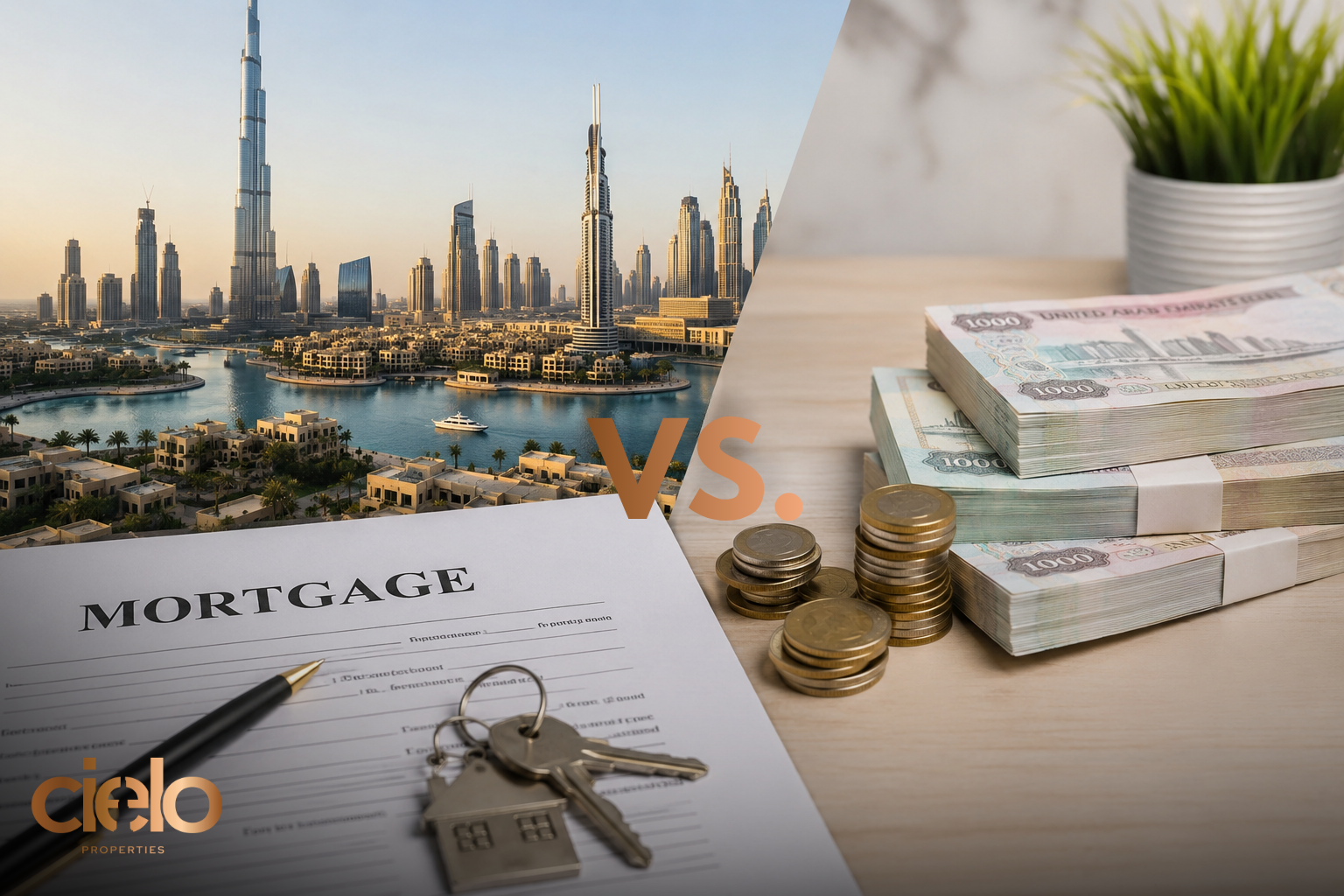
That’s most of what’s out there on this topic. And honestly, Cash vs. mortgage in Dubai isn’t a theoretical debate. It’s a real decision with real money on the line, and the stakes are completely different here than anywhere else in the world.
I’ve sat across from hundreds of buyers. Some had AED 3 million sitting in an account. Some needed 90% financing. Some thought cash was the obvious “smart” move and walked away from properties that tripled in value because they tied everything up in one unit. Others mortgaged wisely, kept their capital working, and built portfolios while staying liquid.
So let me just tell you what I actually think.
The cash buyer’s superpower nobody talks about enough
Look, the obvious stuff is true. No interest. No bank fees. No 0.25% DLD mortgage registration on top of everything else. Fewer approvals. Faster close. You get the keys and it’s done.
But here’s what I think is underrated: negotiating power.
A cash buyer in Dubai is genuinely treated differently. Developers, and especially secondary market sellers, will discount for certainty. I’ve personally seen cash buyers save 5–8% off asking prices just because a seller didn’t want to wait for bank approvals. That’s not nothing. On a AED 2 million unit, that’s AED 100,000–160,000 back in your pocket before you’ve even unpacked.
And in off-plan specifically, some of the most attractive early-bird prices go to buyers who can commit clean and fast. Developers have cash flow targets. If you can satisfy that immediately, you become their favourite person in the room.
So cash isn’t just “simple.” It’s genuinely strategic, if your financial situation supports it.
But here’s where cash buyers get it wrong
Tying up AED 2 or 3 million in a single property while leaving yourself with minimal reserves… that’s not investing. That’s concentrating.
Think about it this way: if the market softens for 18 months, and markets do, even good ones, you can’t tap your apartment wall for cash. You’re either holding and riding it out or selling at exactly the wrong time.
I’ve seen this happen. Not often, but enough. Someone goes all-in on cash, feels amazing about owning it free and clear, then hits an unexpected business disruption or a family situation. And suddenly the illiquid asset that was supposed to be security becomes a source of stress.
If buying cash means you’re left with very little liquidity, honestly? That’s worth a hard conversation before you sign anything.
The case for mortgage, and why leverage isn’t a dirty word
Mortgage has a bit of a bad reputation that I don’t think it deserves. At least not in Dubai’s context.
Here’s the real story. If you can secure a mortgage at, say, 4–5% interest and deploy your remaining capital into an off-plan with 10–15% projected annual appreciation… you’re not borrowing money. You’re using leverage to amplify returns. That’s what institutional investors do every single day.
On top of that, you’re keeping your cash liquid. Which means you can take on another unit. Or park funds somewhere else that generates returns. You’re not locked in.
For expats especially, this matters enormously. Your financial life doesn’t exist only in Dubai. You might have investments, obligations, opportunities back home or elsewhere. Mortgaging here means you can stay diversified.
And yes, a mortgage does improve your credit profile in the UAE, which compounds into future borrowing capacity. That’s a real benefit if you’re thinking beyond just one property.
The honest downsides of mortgaging
Interest adds up. Over 20–25 years, the total you pay back can be significantly higher than the original purchase price. That’s just maths.
And getting approved isn’t guaranteed. Banks here want stable income, a clean credit history, and they’ll scrutinise your debt-to-income ratio carefully. If you’re self-employed, non-resident, or recently relocated, expect the process to take longer than you’d like.
There’s also the rate risk. Most UAE mortgages are EIBOR-linked, meaning variable rate. What looks comfortable today at 4.5% could shift if interest rate conditions change. Not dramatically, but worth knowing.
So which one is actually better?
Genuinely? Neither. And both. It depends on three things.
How much liquidity you’d have left after going cash. If the answer is “enough to sleep well and handle surprises,” cash is probably cleaner. If the answer is “barely any,” reconsider.
What you’d actually do with the capital you kept back. If you’d let it sit in a current account earning 0.5%, the math starts favouring cash. If you have real plans for that capital, more property, diversified investments, or a business opportunity, leverage starts making sense.
Your timeline and exit strategy. Staying long-term? Mortgage’s interest cost gets diluted by appreciation over time. Buying for a shorter flip? Cash closes faster, executes cleaner, and removes financing risk from your exit.
One more thing I always tell people
Don’t make this decision based on a generic article. Make it based on your numbers. Your situation. Your risk tolerance.
Pull out what you actually have. What you’d have left after a cash purchase. What rent you’re currently paying that a mortgage payment could replace. Run those numbers honestly, ideally with a financial advisor and a good broker who’ll tell you the truth rather than just close a deal.
And if you’re still on the fence, I’m happy to walk through it with you the same way I would with a friend. Because that’s exactly how decisions like this should be made.
At Cielo Properties, we specialise in premium off-plan in Dubai. If you want a real conversation about what makes sense for your situation — no pressure, no pitch — reach out. We’re here for it.