

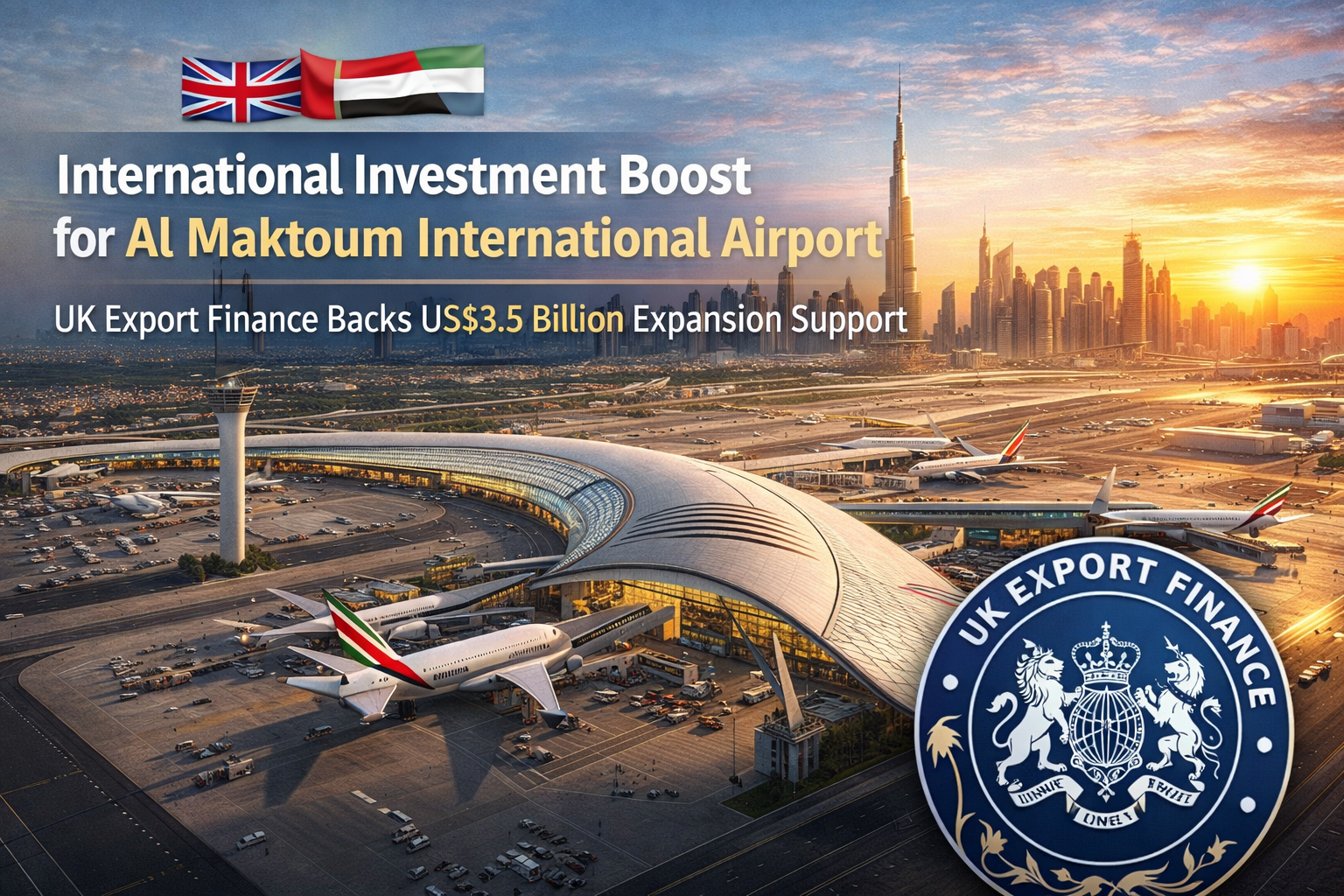
Dubai’s aviation ambitions received a major international endorsement at Dubai Airshow 2025, as UK Export Finance (UKEF) issued a US$3.5 billion Expression of Interest letter to support UK business participation in the US$35 billion expansion of Al Maktoum International Airport at Dubai World Central (DWC). The announcement signals growing global confidence in one of the world’s most ambitious airport infrastructure projects.
More than a financing headline, this development reflects how Al Maktoum International is positioning itself as a long-term engine for aviation growth, trade, and global connectivity. With its initial phase expected in the early 2030s and a long-range plan that stretches decades ahead, the project is designed to help shape the future of air travel from Dubai.
A Major Vote of Confidence in Dubai’s Aviation Future
The announcement was made during Dubai Airshow 2025, where the UKEF Expression of Interest letter was formally presented by Sir Chris Bryant, UK Minister for Trade, to H. E. Eng. Khalifa Al Zaffin, Executive Chairman of Dubai Aviation City Corporation and Dubai Aviation Engineering Projects, and Paul Griffiths, CEO of Dubai Airports.
What makes this moment especially significant is that it is described as the first international expression of interest of its kind for the Al Maktoum International mega-project. That gives the announcement more weight than a routine partnership update. It suggests that international institutions are not only watching Dubai’s airport expansion closely, but are prepared to support the businesses that may help build it.
In practical terms, that matters because large infrastructure projects depend on more than local planning. They require global supply chains, engineering expertise, financing support, and trusted long-term partnerships. This latest step shows that Al Maktoum International is attracting that kind of attention.
Why Al Maktoum International Matters
Al Maktoum International Airport is not being expanded as a standard airport upgrade. It is being developed as a transformational aviation project intended to serve Dubai’s growth over the next 50 years. According to the announcement, the initial development phase is planned to come online in the early 2030s, with capacity for up to 150 million passengers annually. Over the longer term, the airport is expected to scale to 260 million passengers.
Those numbers make it clear that this is not just about increasing runway space or terminal size. It is about building an airport ecosystem that can support future demand at a completely different scale.
For readers outside the aviation sector, the bigger picture is simple: as cities grow and global travel patterns evolve, airports become more than transport hubs. They become economic platforms. A major airport expansion can influence tourism, trade, logistics, investment, and how a city connects to the rest of the world.
The Role of UK Export Finance
The UKEF Expression of Interest letter opens the door for UK companies to potentially take part in the airport’s next development phases. The support is aimed at helping British businesses engage in the expansion of DWC, which is valued at US$35 billion.
That is important for two reasons.
1. It boosts international participation
Large-scale airport projects need specialist expertise across multiple areas, including:
- Advanced engineering
- Airport systems and infrastructure
- Sustainable construction solutions
- Smart mobility and integrated transport
- Long-term operational planning
The UKEF support indicates that qualified UK suppliers could have a pathway to participate through Dubai’s procurement frameworks.
2. It strengthens confidence in project delivery
When international export finance institutions publicly express interest in backing supplier participation, it often signals confidence in the project’s structure, governance, and long-term viability. In this case, Dubai officials framed the airport expansion as a structured programme built on advanced engineering, resilient design, and disciplined long-term planning.
That framing matters. It tells investors and industry partners that the project is being positioned as methodical and future-focused, not just visionary.
A Project Built Around Long-Term Planning
A recurring theme in the announcement is that Al Maktoum International is being planned with the future in mind. Officials described the expansion as an engineering-led programme with a focus on:
- Clear technical standards
- Modular construction
- Sustainability
- Resilient infrastructure
- Disciplined delivery frameworks
That language may sound technical, but the idea is straightforward. Dubai is aiming to build an airport that can adapt over time rather than become outdated too quickly.
This is particularly relevant in modern aviation, where airports are under pressure to handle rising passenger expectations, changing airline operations, environmental targets, and stronger integration with surrounding transport systems. The article notes that the project will place emphasis on innovation, sustainability, and integrated transport systems, suggesting that the airport is being imagined as part of a wider mobility network rather than a standalone facility.
More Than an Airport Expansion
One of the strongest messages in the original announcement is that this project is tied directly to Dubai’s broader economic and strategic vision.
H. E. Eng. Khalifa Al Zaffin said the expansion will help unlock the next stage of Dubai’s aviation growth and support the leadership’s vision of making Dubai the aviation capital of the world. Paul Griffiths also described the airport as a once-in-a-generation opportunity to rethink how airports should work and how the passenger journey of the future should feel.
Taken together, these statements show that Dubai is not simply focused on building a larger airport. It is trying to redefine what airport infrastructure can deliver in terms of experience, connectivity, and economic impact.
That distinction is important for website readers, investors, and business audiences alike. The value of the project lies not only in size, but in what that size enables:
- Greater global connectivity
- New business and supplier opportunities
- Increased passenger capacity
- Stronger links between aviation and economic development
- A long-term platform for future mobility and commerce
Why International Momentum Matters Now
International support at this stage creates momentum. It helps move a project from ambition to execution by attracting attention from suppliers, financiers, infrastructure partners, and industry stakeholders.
The ceremony itself reflected that broader significance. According to the announcement, it was attended by His Excellency Edward Hobart, the British Ambassador to the UAE, senior leaders from Dubai Airports, Dubai Aviation City Corporation, Dubai Aviation Engineering Projects, Dubai South, officials from the British Embassy in the UAE, ministerial delegates, aviation partners, and international media.
That level of representation suggests the project is being viewed as more than a local infrastructure development. It is being treated as a globally relevant aviation initiative with long-term strategic value.
What This Means for Dubai’s Future
For Dubai, the expansion of Al Maktoum International Airport is part of a much larger story about growth, competitiveness, and infrastructure leadership.
As the city continues to strengthen its position as a global hub for travel, trade, and innovation, airports will remain central to that identity. A next-generation airport with the scale, planning, and international backing described in this announcement could play a defining role in how Dubai competes over the coming decades. That is an interpretation based on the scale, timeline, and strategic language in the announcement.
Conclusion
The UKEF’s US$3.5 billion Expression of Interest letter is more than a symbolic gesture. It is a clear sign that international confidence in the Al Maktoum International Airport expansion is building. With a US$35 billion development plan, projected capacity of 150 million passengers in the early 2030s, and long-term ambitions reaching 260 million passengers, the project stands out as one of the most important aviation developments on the horizon.
For businesses, it signals opportunity. For Dubai, it reinforces momentum. And for the global aviation industry, it offers a glimpse into how the next generation of airport infrastructure may be planned, financed, and delivered.