

You know that moment when a city does something, and you think… okay, they’re actually serious?
That was me when the Dubai Loop announcement dropped.
I’ve been in this market long enough to remember when the Metro was just a promise on a map. People nodded politely and went back to their cars. Then the Metro opened, and overnight, the conversation about which areas were “accessible” completely flipped. Neighborhoods near stations started pulling premiums. Developers scrambled to mention metro proximity in every brochure.
We’re at that same inflection point right now. And honestly? I think most people haven’t fully registered what’s happening.
So What Actually Is the Dubai Loop?
Let me break it down simply.
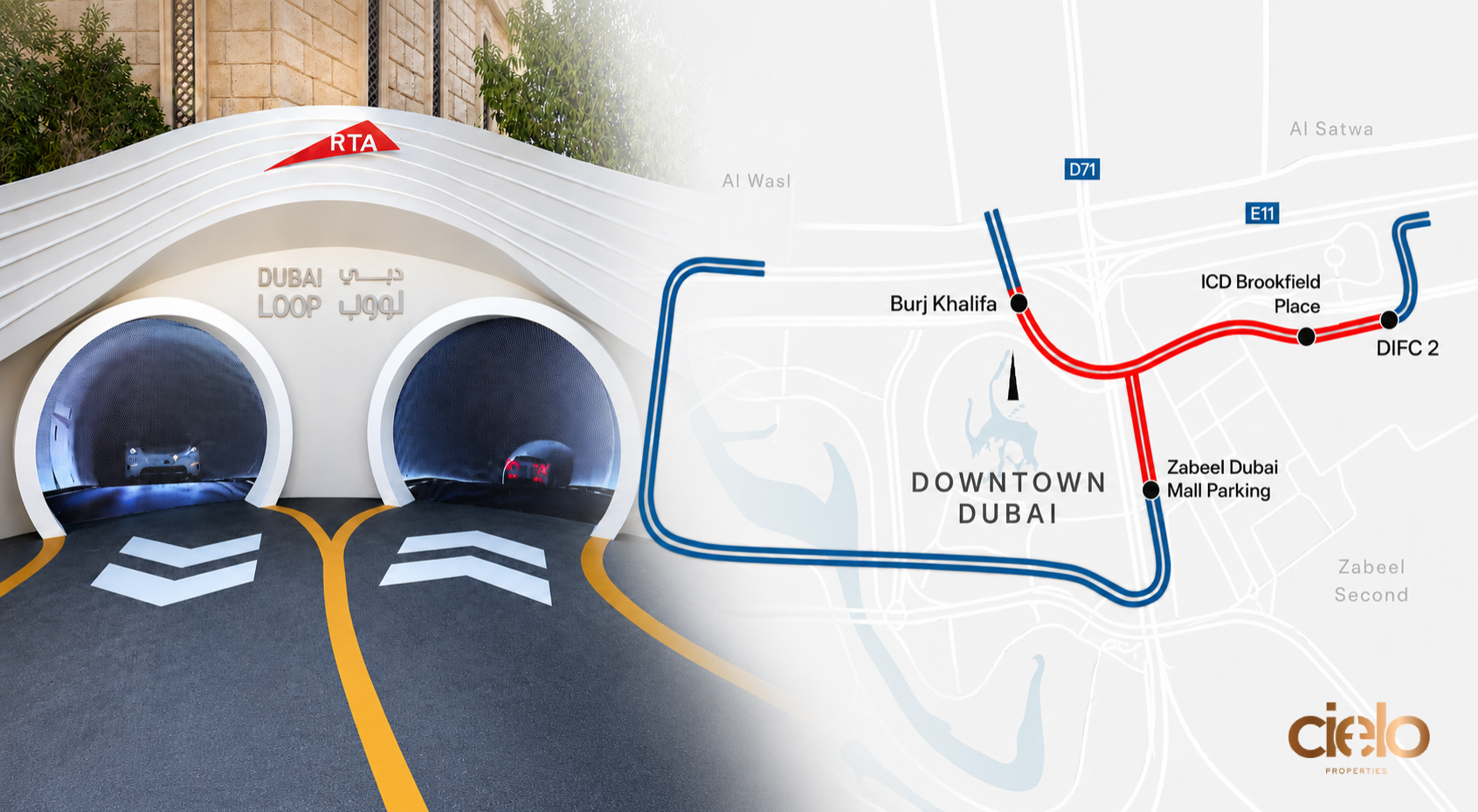
The Dubai Loop is an underground tunnel transport system, think Teslas in tunnels, developed by Elon Musk’s The Boring Company. Dubai is the second city in the world to adopt it, after Las Vegas.
The full network will span 24 kilometres, with 19 stations and a total estimated cost of Dh2.5 billion.
But here’s where it gets interesting for anyone watching the property market.
The first phase, 6.4km at an investment of Dh600 million, will have four stations: Burj Khalifa, DIFC 2, Zabeel Dubai Mall Parking, and ICD Brookfield Place. That’s the DIFC-to-Dubai Mall corridor. One of the most premium, densely transacted stretches of real estate in the entire city.
And the headline number? This system will reduce travel time between DIFC and Dubai Mall from 20 minutes to just three minutes, with 100 cars operating inside the tunnels and capacity for up to 13,000 passengers per day.
Three minutes. Let that land for a second.
Why This Is a Bigger Deal Than It Sounds
Here’s what I mean when I say people aren’t fully registering this yet.
Dubai traffic is… well, you live here, you know. The commute between DIFC and Dubai Mall at 6 pm on a Thursday is a genuine test of character. It’s not just inconvenient, it’s the kind of friction that actually shapes where people choose to live and work. Where they’re willing to pay a premium. Where they’d rather not be.
Infrastructure that eliminates friction doesn’t just make commutes easier. It reshapes the mental map of the city.
Think about it this way: when you can get from your office in DIFC to dinner at the Dubai Mall in literally three minutes, the distance between those two places functionally disappears. They become one zone. And when two premium locations merge into one connected zone… prices tend to respond accordingly.
The Cost Advantage Nobody’s Talking About
There’s another piece of this story that I find quietly fascinating from an infrastructure standpoint.
Excavation using this tunneling technology costs around Dh70 million per kilometre, compared to Dh125 million per kilometre with conventional tunneling methods. That’s almost half the cost.
Why does that matter to you as a buyer or investor? Because it means the city can actually afford to expand this network. Work on subsequent phases is planned to begin earlier than initially scheduled if progress allows. This isn’t a one-off vanity project. It’s the seed of a broader transport layer that will grow.
The 19-station, 24km full network is the destination. The four-station first phase is just the beginning of the conversation.
What This Means If You’re Buying Off-Plan Right Now
I’ll be direct with you because that’s kind of the whole point of these posts.
The areas sitting inside or adjacent to the Loop’s footprint — DIFC, Downtown, the Dubai Mall catchment — were already among the most sought-after in the city. We’re not discovering some hidden gem here. But what the Loop does is add a new layer of future-proofing to assets in those zones.
Buyers who purchased near Metro stations before they opened didn’t regret it. The pattern in Dubai is consistent: announced infrastructure moves the market before a single shovel breaks ground, and it moves again when the ribbon gets cut.
RTA has signed the construction agreement, and completion is expected within one to two years. That’s a relatively short runway for a project of this scale. Which means if you’re looking at off-plan in the Loop corridor, the window between “early mover” and “everyone already knows” is narrowing.
One More Thing Worth Sitting With
The pricing for using the Loop hasn’t been confirmed yet, but the RTA has said it will be “competitive” compared to other transport options between those locations.
Accessible pricing matters more than people realise. Premium infrastructure that’s actually affordable to use daily becomes woven into the city’s fabric in a way that luxury-priced transport never does. If the Loop ends up being genuinely accessible — not just a novelty — its effect on the surrounding real estate market will be deeper and longer-lasting.
Look, I’m not saying buy everything between DIFC and Downtown tomorrow. That’s not how this works, and that’s not the kind of advice I’d give a friend.
What I am saying is: when a city announces it’s building a system that makes its most premium corridor function like one seamless neighbourhood, and that system is being built at half the cost of conventional tunnelling, with a realistic one-to-two year delivery timeline… you want to be paying attention.
The map of Dubai is being redrawn. It happens every few years here, and the people who catch it early are rarely the ones who waited until it was obvious.
If you’re trying to figure out how this affects a specific area you’re looking at — or which off-plan projects sit inside this story — drop me a message. Happy to walk through it.