

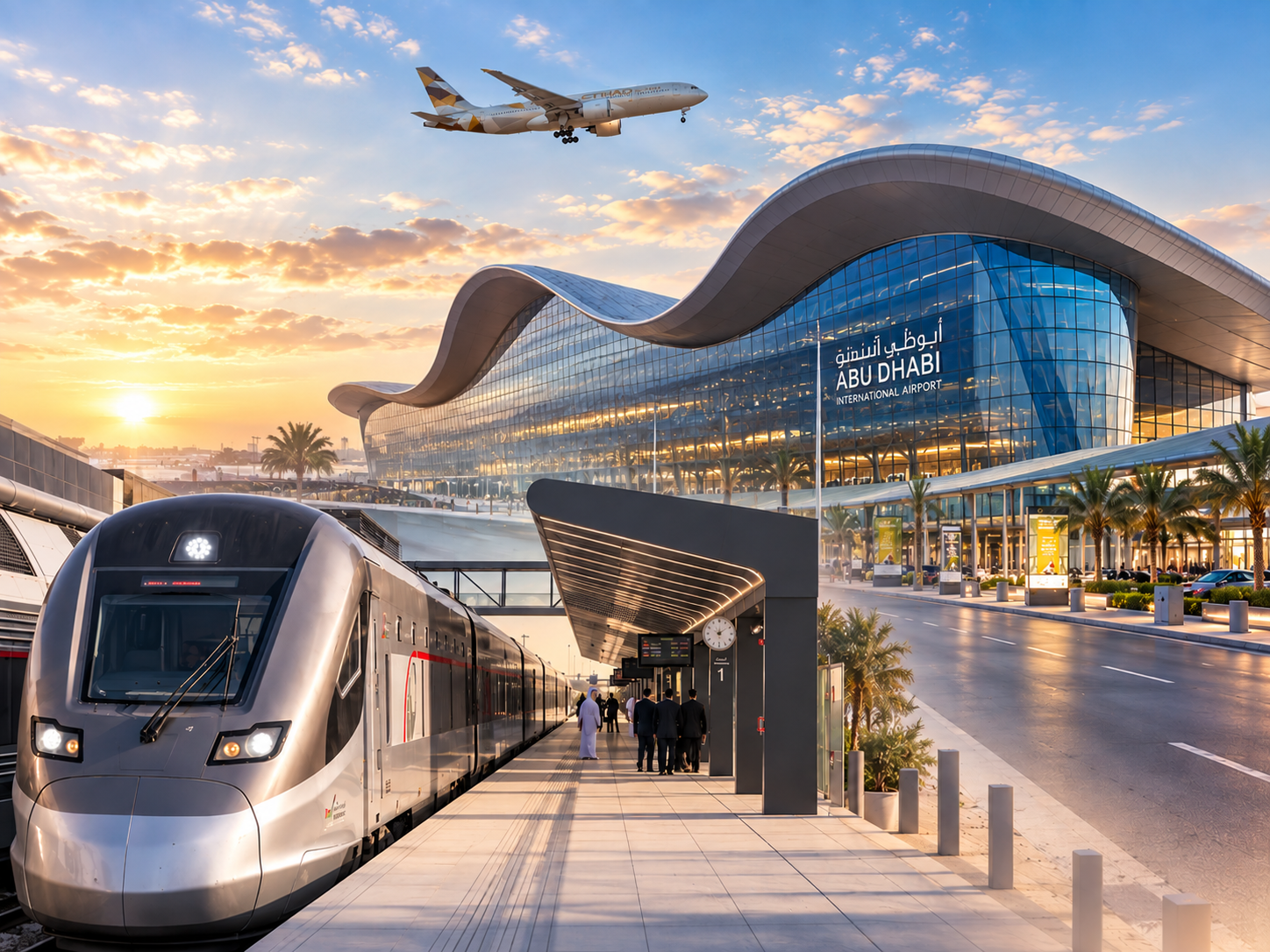
The news out of Abu Dhabi on September 16, 2026, is genuinely interesting. Etihad Airways and Etihad Rail have signed an MoU to explore better connectivity between Zayed International Airport and Mohamed bin Zayed City Passenger Station, including dedicated shuttle services. They’re also exploring integrated air-and-rail booking and station-based passenger services.
That matters.
How easy a place is to reach. How easy it is to live there. How smoothly somebody can step off an international flight and continue across the UAE without rebuilding the journey from scratch.
And when you’re buying property for the next five, seven or ten years, little changes in how people move around can eventually become pretty big changes.
First, let’s be clear about what was actually announced
There’s a small but important distinction here.
The Etihad Rail station in Abu Dhabi will connect directly to the airport. But read into the announcement, and the language is more careful: Etihad Airways and Etihad Rail have signed a memorandum of understanding to explore better connectivity between Zayed International Airport and Mohamed bin Zayed City Passenger Station. One option being studied is dedicated shuttle services between the airport and the railway. Integrated air-and-rail booking and station-based passenger services are also on the table.
Mohamed bin Zayed City Passenger Train Station was inaugurated on June 23. Scheduled passenger services between Abu Dhabi and Fujairah began their introductory operational phase on June 30, with a journey of about one hour and 45 minutes.
And the rollout is continuing.
Etihad Rail currently says Dubai and Al Dhaid stations are due to open on September 30, 2026, followed by Zayed City and Liwa on November 30, the remaining Al Dhafra stations on December 30, and Sharjah on March 30, 2027.
The broader passenger plan covers 11 cities and key hubs, and Etihad Rail says its fleet comprises 13 trains carrying up to 400 passengers each.
And people are already booking it in serious numbers.
By August 3, Etihad Rail said it had sold more than 70,000 passenger tickets, with customers booking an average of 12 days ahead. That was during the introductory phase, before the Dubai station had even opened.
Why an airport connection matters more than it sounds
Think about arriving in Abu Dhabi.
You’ve just spent seven hours on a plane. Your suitcase somehow weighs twice what it did when you left home. Your phone has 14% battery. Maybe you’ve got two children asking whether you’re there yet.
Nobody in that situation is thinking about “multimodal transport integration.”
You’re thinking: How do I get where I’m going without making this complicated?
That’s what good infrastructure really does.
It removes little pieces of friction.
Zayed International Airport handled 32.5 million passengers in 2025, up from 28.8 million in 2024. Abu Dhabi Airports said AUH was the fastest-growing mega airport in Europe, the Middle East, and Africa over the 12 months to October 2025, while 2025 brought 39 route launches and seven additional airlines.
So we’re not talking about connecting the railway with a sleepy regional terminal.
We’re talking about creating a smoother link between the UAE’s emerging national passenger rail system and an airport that handled 32.5 million people last year.
Here’s what I mean
Imagine somebody flying into Abu Dhabi. If the eventual system allows them to book the flight, transfer easily to Mohamed bin Zayed City station, and continue by rail toward Dubai, Fujairah, or another connected destination, Abu Dhabi stops functioning only as their airport.
It becomes the front door to a much bigger journey.
And that’s pretty much the ambition Etihad Airways described: use Abu Dhabi as the gateway, then make onward travel across the UAE easier.
In real estate, convenience is a kind of currency
I’ve always thought of inconvenience as a hidden tax on property.
A bad junction is a tax.
A painful commute is a tax.
Having to build an extra 45 minutes into every airport trip is a tax.
Better transport can remove some of those taxes.
But it doesn’t magically turn an average apartment into a brilliant investment.
International research broadly supports the idea that improved rail accessibility can become reflected in land and property values. The problem- and this is the bit that usually disappears from sales brochures is that the effect varies enormously depending on the type of rail, land use, station quality, distance, road access, local market, and maturity of the network.
There is no honest universal rule saying, “rail equals a 10% property premium.”
And none of those international studies gives us an Abu Dhabi percentage.
Anyone pretending they do is stretching the research.
A 2026 study of Montreal’s REM light-rail project makes the point nicely. Researchers looked across the announcement, construction, testing, and early-operation stages and found that property-price effects changed across phases and locations. Some areas saw premiums after the announcement; in others, gains were later reduced around the operating branch.
So markets can react before the first train arrives.
But not uniformly.
That’s an important distinction for Abu Dhabi right now, because transport infrastructure is expanding at the same time as the property market itself is moving quickly.
ADREC’s first-half 2026 data recorded AED70.4 billion in residential unit sales, with off-plan transactions accounting for 89% of sales value and 82% of deals. Repeat-sale prices were up 20% year-on-year for apartments and 12% for villas.
Prices on new residential leases also rose in the first half: 17% for apartments and 9% for villas across the emirate, with stronger increases inside investment zones. That’s specifically new-lease pricing, by the way, a useful distinction given Abu Dhabi’s separate temporary 0% cap on renewal increases introduced in June.
Abu Dhabi property is already moving. The infrastructure story is another layer on top of that.
Total real-estate transactions reached AED 117 billion in the first half of 2026. ADREC also reported AED 13.8 billion in real-estate FDI, while non-resident investors from 116 nationalities were active in the market.
That context matters.
So where would I actually pay attention?
This is where I’d slow down.
Because the temptation is obvious: draw a five-kilometre circle around Mohamed bin Zayed City station and call everything inside it “the next investment zone.”
Real estate doesn’t work that neatly.
I’d start with Mohamed bin Zayed City itself and the wider station catchment, obviously, but I would study it first as an occupier and mobility story.
Who will actually use the station?
Where will they work?
How do they get from the station to the building?
What do the last five or ten minutes of the journey feel like?
That last question matters more than people think.
A station can be geographically close and practically annoying.
Or slightly farther away and incredibly easy to use.
And remember, the broader MBZ City area isn’t disconnected from the airport today. Zayed International Airport already lists the A10 public bus to MBZ City Bus Station. That’s the bus station, not the Etihad Rail passenger station an important distinction. The new partnership is about exploring a more seamless rail-airport transfer, rather than inventing transport connectivity from nothing.
Then I’d watch Khalifa City and Zayed City.
Not because I’m telling you this announcement automatically makes either area more valuable tomorrow morning.
It doesn’t.
But because supply is growing in that wider part of Abu Dhabi while the transport map is changing at the same time.
ADREC projects roughly 71,000 additional residential units across the emirate through 2030, with deliveries expected to peak at about 21,800 units in 2028. Six districts- Saadiyat Island, Reem Island, Yas Island, Zayed City, Khalifa City, and Hudayriyat Island are expected to drive 77% of projected incremental supply.
Read that again, because this is the other half of the investment equation.
Better infrastructure can support demand.
But new supply creates competition.
A beautiful transport story won’t rescue an overpriced one-bedroom apartment if a large amount of similar stock hands over around it.
That’s why I don’t analyse infrastructure without looking at the delivery pipeline.
Yas Island is interesting for a slightly different reason.
ADREC recorded AED7.3 billion in residential sales there during the first half of 2026.
Yas already sits inside Abu Dhabi’s tourism and leisure economy. So a smoother airport-to-national-rail journey would add another layer to a location whose investment story is already heavily tied to visitor access and mobility.
Would I increase my rental forecast tomorrow because of this MoU?
No.
Would I include better integrated transport in my long-term view of Abu Dhabi’s airport-side and tourism-oriented communities?
Absolutely.
There’s a difference.
The off-plan angle is where this gets really interesting
This is probably the part I care about most as a broker.
When you buy a ready property, you’re mostly buying today.
Today’s road.
Today’s neighbourhood.
Today’s tenant.
Today’s rent.
Off-plan is different.
You might be standing in a sales centre in September 2026 buying an apartment that doesn’t hand over until 2028 or 2029.
You’re buying a future version of the city.
And that’s why infrastructure matters.
Etihad Rail is expanding its passenger service in stages now: Dubai and Al Dhaid on September 30, Zayed City and Liwa on November 30, the remaining Al Dhafra stations on December 30, then Sharjah in March 2027. The airport integration announced this week is still early in its journey still an MoU to explore options, with no shuttle launch date announced.
Meanwhile, Abu Dhabi’s residential delivery pipeline is expected to build towards its 2028 peak.
Put those timelines beside each other.
That’s the interesting bit.
Someone buying off-plan today isn’t simply betting on what Abu Dhabi looks like in September 2026. They’re buying into a period when tens of thousands of homes are expected to be delivered while the country’s transport system is also becoming substantially more connected.
But here’s where buyers get into trouble…
They treat every planned infrastructure project as though it has already happened.
I don’t.
When I’m underwriting an off-plan investment, I want the property to make sense without the optimistic scenario.
A dedicated airport shuttle launches and works brilliantly.
Great.
Integrated flight and rail bookings make transfers genuinely easier?
Even better.
Etihad Rail becomes part of everyday inter-emirate travel?
That’s potential upside.
But I don’t want the investment case to collapse if the shuttle takes longer than expected, passenger behaviour develops differently, or your particular building turns out to have a clumsy last-mile journey to the station.
That’s not pessimism.
That’s how you stop yourself paying tomorrow’s price for today’s uncertainty.
What I’d do if I were buying after this announcement
I’d resist the urge to rush.
Seriously.
Infrastructure announcements have a funny effect on people. Suddenly a property that was AED1.8 million yesterday feels like it must be bought today because somebody drew a railway line on a presentation.
Breathe.
Then ask four very boring questions.
Where exactly is the property relative to the infrastructure people are talking about?
Not “near Etihad Rail.”
Show me the journey.
Front door to station entrance.
Tuesday morning.
Real roads.
What’s the last mile actually like?
A brilliant national railway with a terrible 20-minute connection from your building still leaves you with a terrible 20-minute connection.
How much competing property will exist when mine hands over?
This matters enormously when Abu Dhabi is heading into a substantial residential delivery pipeline.
And finally:
Would I still buy this unit if I assumed zero “Etihad Rail premium”?
That’s my favourite question.
Because if the answer is yes, if you still like the developer, layout, view, payment plan, entry price, service charges, rental audience, and surrounding supply, then infrastructure becomes what it should be.
Upside.
Not an excuse.
At Cielo Properties, that’s how we read news like this. We don’t need to turn every infrastructure announcement into a property sales pitch. Cielo’s wider positioning is built around long-term relationships, transparency, and helping clients make informed decisions, and this is exactly the kind of announcement where that approach matters.
So before you reserve a property because somebody says it’s “near Etihad Rail,” ask to see three things: the real door-to-station journey, the competing supply around your handover date and the investment case with zero rail premium built into it.
Then look at the upside.
Because over the long run, the locations that work aren’t just the ones with the tallest towers or the nicest renders.
They’re the places where life gets easier.
Where getting home is easier.
Where getting to work is easier.
Where somebody can land, collect their bag and keep moving without having to think too hard about it.
That’s what good infrastructure eventually becomes.
Not a headline.
Just… normal life.
And when a city reaches that point, that’s when you realise the map has changed.