

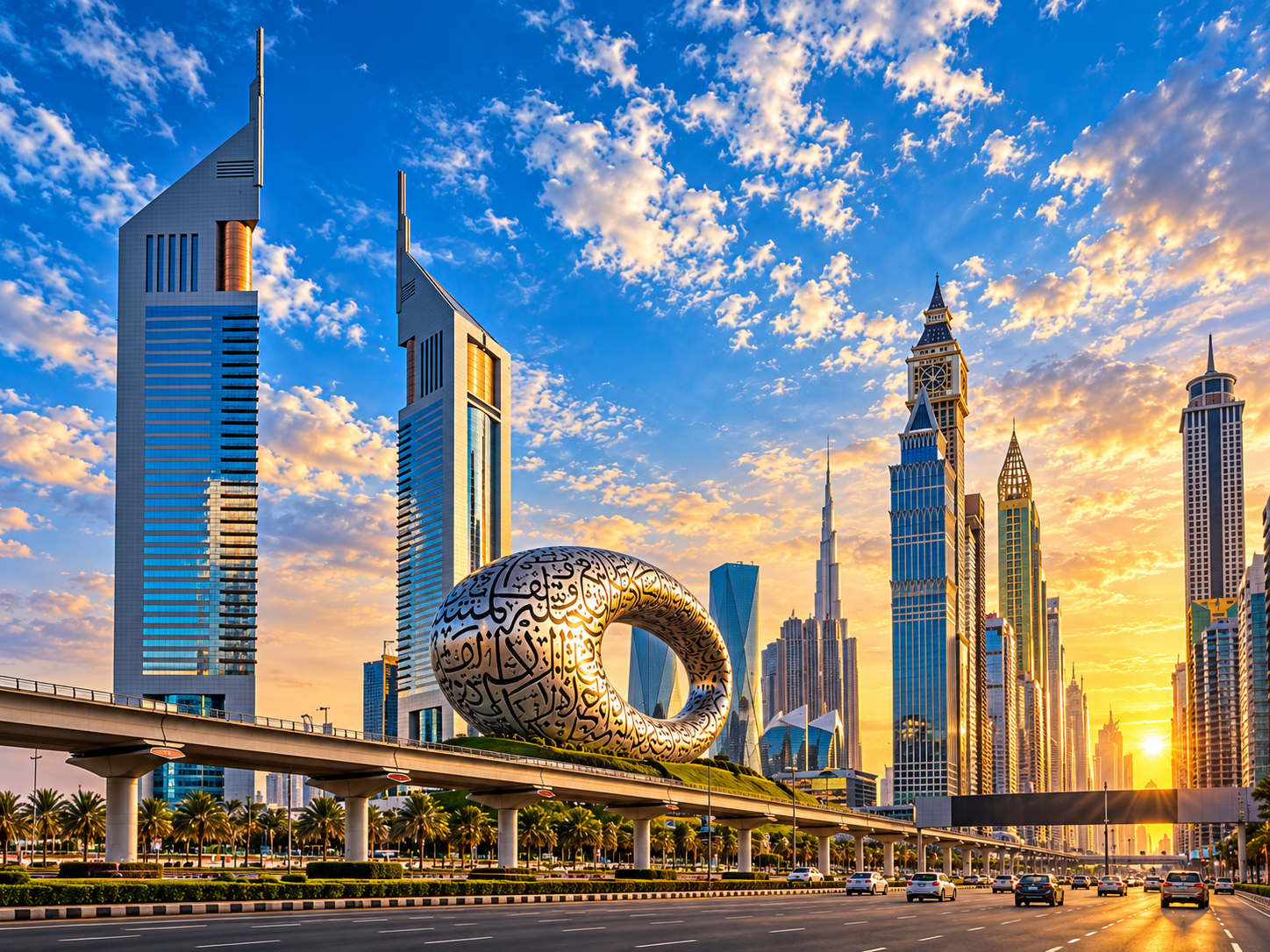
Dubai property sales have crossed $103 billion in the first nine months of 2026, making it the second-highest nine-month sales total on record.
Big number. No question.
But the interesting part isn’t really the $103 billion.
It’s what happened underneath it.
Because if you’re thinking about buying property in Dubai right now, whether it’s an off-plan apartment, a villa for the family, or something you’re hoping to rent out later, the headline alone doesn’t tell you enough.
So let’s unpack it properly.
First, the number everyone is talking about
According to an analysis of Dubai Land Department data, property sales exceeded AED 380 billion, roughly $103.47 billion, across more than 123,000 transactions between January 1 and September 29, 2026. That makes 2026 the second-highest sales period on record for the first nine months of a year.
The only year ahead of it?
During the same period last year, Dubai recorded AED 495.8 billion in property sales across 157,306 transactions. For a little more perspective, sales during the first nine months of 2024 were around AED 374 billion.
And this is where people sometimes read the numbers the wrong way.
Yes, 2026 is below 2025.
Quite noticeably.
But 2025 was an extraordinary year. Comparing every year that follows to a record year can make a perfectly active market look weak when it isn’t.
Think about it this way.
If you run your fastest marathon ever and finish the next one a few minutes slower, you haven’t suddenly forgotten how to run.
You just didn’t break your own record again.
That’s roughly how I’d look at Dubai’s property numbers right now.
So… is Dubai’s property market actually slowing?
In some parts of the market, yes, the pace has cooled from last year’s exceptional levels.
And I don’t think investors should pretend otherwise.
Third-quarter property sales reached approximately AED 92.3 billion across 37,124 transactions, compared with AED 169 billion across 59,044 transactions during the same quarter of 2025.
September tells a similar story.
Property sales for the month reached approximately AED 28.7 billion across 11,063 transactions. When mortgages and property gifts are included, total September real estate transactions came to roughly AED 49.22 billion across 15,531 transactions.
So the market isn’t moving at the same speed it was during the record-breaking period of 2025.
But that’s very different from saying buyers have disappeared.
More than 123,000 sales transactions in nine months is still an enormous amount of activity.
And those transactions weren’t limited to one corner of Dubai.
The first nine months included more than 103,000 residential unit transactions, around 9,500 building transactions and more than 9,600 land transactions.
That’s a broad market.
There’s another number I find interesting: mortgages
This part doesn’t get nearly as much attention as the sales headline.
Mortgage transaction values actually increased by 14%, reaching approximately AED 150.6 billion during the first nine months of 2026, compared with AED 132.21 billion during the same period in 2025.
Why does that matter?
Because it shows that activity isn’t simply coming from buyers arriving with cash and grabbing whatever is available.
Financing is still playing a significant role.
Now, I wouldn’t take that number and jump straight to the conclusion that every mortgaged property represents an end-user buying a family home. Real estate data is rarely that neat.
But it does give us another piece of the picture.
People are still financing property. Banks are still part of the transaction cycle. Buyers are still committing meaningful amounts of capital.
And when you combine sales, mortgages and property gifts, Dubai recorded more than AED 575 billion in total real estate transactions across 159,908 transactions during the period covered by the analysis.
One small but important distinction here: that AED 575 billion figure includes sales, mortgages and gifts. It isn’t another AED 575 billion on top of the AED 380 billion in sales.
Sounds obvious… but you’d be surprised how often those numbers get mixed together.
What does all of this actually mean if you’re buying?
Here’s where I’d stop looking at Dubai as one giant property market.
Because it isn’t.
Dubai Marina behaves differently from Dubai Hills.
Dubai Creek Harbour isn’t Palm Jebel Ali.
A one-bedroom apartment purchased primarily for rental income has a completely different investment case from a five-bedroom villa bought for long-term capital preservation.
And an off-plan property completing in 2030 shouldn’t be assessed the same way as a ready apartment you could rent next week.
That’s why the headline “Dubai property sales cross $103 billion” is useful for understanding the size of the market, but it’s not enough to decide whether a particular property is worth buying.
At Cielo Properties, this is something we keep coming back to with clients.
You’re not really buying “the Dubai property market.”
You’re buying one particular unit, in one particular development, at one particular price, from one particular developer.
That distinction matters.
A strong market won’t rescue a badly priced property.
And a slower market doesn’t automatically make a well-bought property a bad investment.
I actually think buyers need to be more selective now
And that’s not necessarily a bad thing.
When markets are moving very quickly, people can get caught up in urgency.
A launch happens. Units start moving. WhatsApp groups light up. Someone says inventory is nearly gone. Suddenly you’re being asked for an EOI before you’ve properly looked at the floor plan.
You know the feeling.
But when the market becomes a little more measured, buyers get something valuable back.
Time to compare.
That’s where I’d be spending my energy now.
How does the price per square foot compare with similar projects nearby? What has already been sold in the area? How much competing supply is expected around the handover period? Is the payment plan genuinely attractive, or has the cost simply been built into a higher purchase price? Who is the developer? What have they delivered before? And, most importantly, who’s likely to buy or rent this property from you later?
Those questions matter far more than whether Dubai recorded AED 370 billion, AED 380 billion or AED 400 billion in sales.
And for off-plan investors, this matters even more
Off-plan is where people can easily get distracted by the launch.
The renders are beautiful.
The lobby looks incredible.
There’s a beach club, a rooftop pool, a cinema room, maybe even a wellness garden with a name nobody had heard of five years ago…
That’s all fine.
But eventually, a property has to stand on its own two feet.
At handover, buyers aren’t comparing brochures anymore. They’re comparing actual apartments, actual views, actual rents and actual resale prices.
That’s why I wouldn’t look at the current Dubai numbers and say, “The market is strong, so anything off-plan should perform.”
That’s not how property works.
The market can be healthy while individual developments underperform.
It can also cool overall while certain communities continue attracting very strong demand.
Your job as a buyer isn’t to predict every movement in Dubai real estate.
It’s to give yourself as many advantages as possible before you sign.
Good entry price. Good location. Sensible supply. A credible developer. A payment structure that suits your cash flow. And an exit strategy that doesn’t depend on everything going perfectly.
Simple things.
But they’re usually the things that matter most.
Don’t confuse “below the record” with “weak”
That’s probably my biggest takeaway from these numbers.
Dubai’s property market isn’t currently matching the extraordinary sales volumes recorded during the same period of 2025.
That’s a fact.
But 2026 has still produced the second-highest first-nine-month property sales value on record, with more than AED 380 billion in sales and over 123,000 transactions. Mortgage transaction values have also risen compared with last year.
Both things can be true at once.
The market can cool from a record high and still remain historically active.
And maybe that’s actually a healthier conversation for investors to have.
Not, “Is Dubai booming?”
Not, “Is Dubai slowing?”
But…
Where is the value now?
Because that’s the question that ultimately affects your money.
If you’re considering buying in Dubai, don’t start with the headline and work backwards until you find a property that fits it.
Start with your goal.
Are you looking for rental income? Capital appreciation? A future home? A five-year hold? Something you can resell before completion?
Get that part clear first.
Then look at the numbers.
Then the location.
Then the developer.
Then the property.
That’s how we approach these conversations at Cielo Properties, because a market with AED 380 billion in sales still contains good deals, average deals, and deals you’d probably be better walking away from.
The trick is knowing the difference.
Data note: Market figures referenced above come from an analysis based on Dubai Land Department data covering January 1 to September 29, 2026. Because the reported period ends on September 29, figures may differ slightly from datasets that include the full calendar month of September.