

By a Senior Broker at Cielo Properties | September 24, 2026
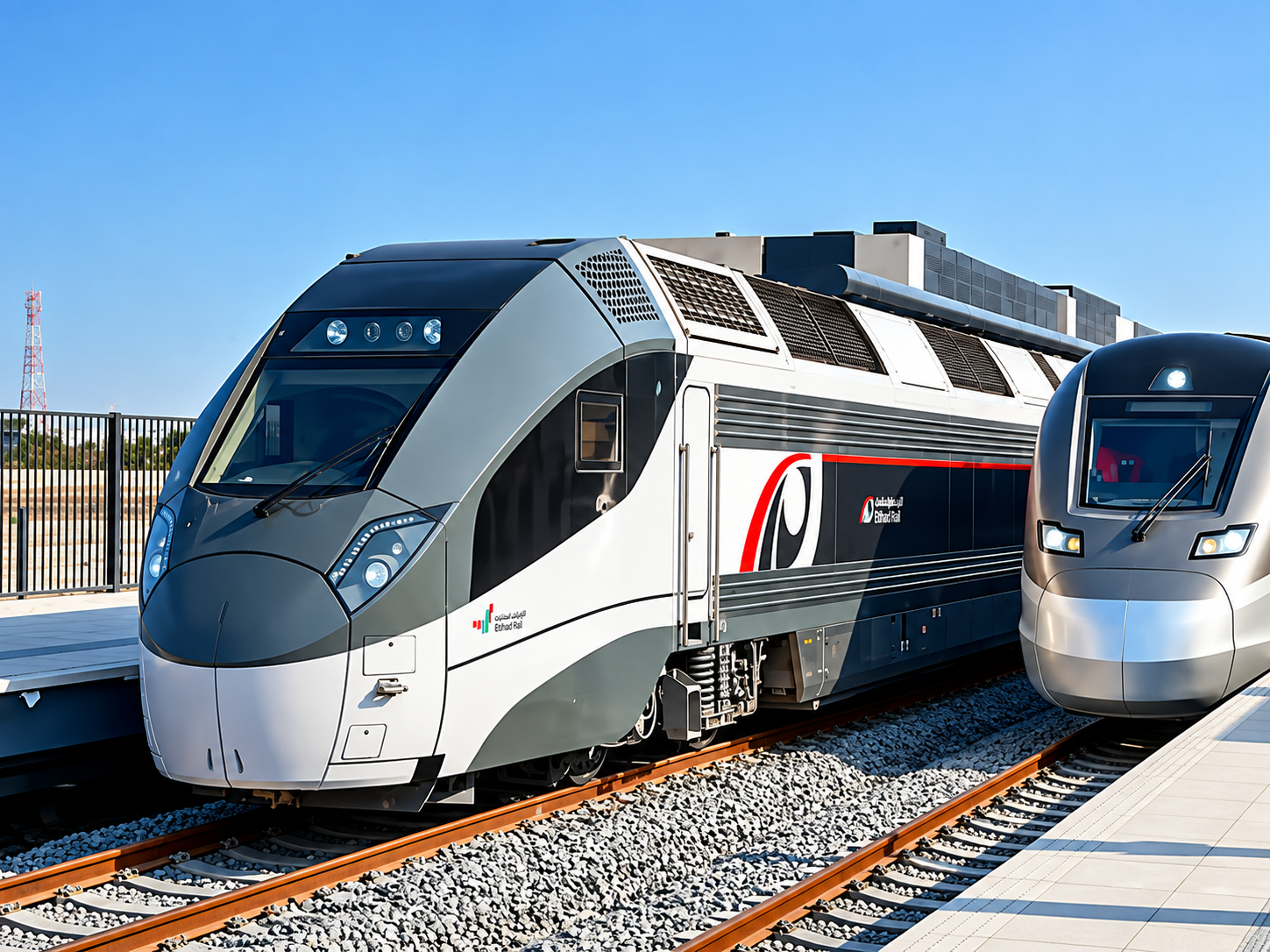
Dubai’s first passenger station at Al Yalayis is scheduled to open on September 30, 2026, connecting Dubai with Abu Dhabi and the wider national passenger network. The Dubai–Abu Dhabi journey is expected to take about 57 minutes station to station. But that’s only the beginning. Dubai is also working on Metro integration, another Etihad Rail connection is emerging around Meydan, a separate high-speed Dubai–Abu Dhabi railway is planned, and Abu Dhabi is looking at linking its rail station more closely with Zayed International Airport.
The thing to watch isn’t the train. It’s the interchange
Let’s start with Al Yalayis.
The easy headline is that you’ll be able to travel between Dubai and Abu Dhabi by passenger train.
Useful? Absolutely. You commute from your front door in Jumeirah Golf Estates, Al Furjan, Dubai Investment Park, or wherever you live, to a station. Then you take the train. Then you still have to get from Mohamed bin Zayed City Station to your office, meeting, university, hotel, or home.
That last bit matters.
A lot.
The current plan is for the Dubai Etihad Rail station to connect directly with Jumeirah Golf Estates Metro Station on the Red Line via a pedestrian link, giving passengers a way to move between the national railway and Dubai’s existing Metro system. RTA has also previously built road infrastructure around Al Yalayis Street and Dubai Investment Park, with further connectivity toward Jumeirah Golf Estates planned.
And then it gets more interesting.
Dubai’s AED 34 billion Gold Line, scheduled to open on September 9, 2032, is planned to run for 42 kilometres with 18 stations. It will connect places including Al Ghubaiba, City Walk, Business Bay, Meydan, Al Barsha South, JVC and Jumeirah Golf Estates. Crucially, RTA says the Gold Line will integrate with Etihad Rail at both Meydan and Jumeirah Golf Estates.
Read that again.
Jumeirah Golf Estates isn’t simply getting a railway station nearby.
It’s gradually becoming a place where local Metro, national rail and the road network meet.
That’s a very different proposition.
And honestly, this is where property conversations usually get oversimplified. Somebody sees “station nearby” and immediately jumps to “prices will rise.”
Maybe.
But that’s skipping a few steps.
The real question is whether the station makes living there meaningfully easier.
“Near Etihad Rail” is going to become a marketing line. Be careful with it
I can already picture the brochures.
Five minutes from Etihad Rail.
Connected to Abu Dhabi.
Future transport hub.
You know how this goes…
And some of those claims will be useful. Others will be doing a lot of heavy lifting.
Here’s what I mean.
Imagine two apartments.
One is technically six minutes from a railway station, but you need a car to get there, the exit backs up every morning, there’s no useful walking route and the apartment itself sits in a weak rental location.
The other is 12 minutes away but has a direct Metro connection, good road access, shops downstairs, schools nearby and an established tenant pool.
Which one benefits more?
Probably not the one with the prettier map pin.
We actually have Dubai data that backs up this more cautious view.
CBRE studied almost 74,000 residential sales transactions and roughly 112,000 rental contracts around Dubai Metro’s Red Line. From the first quarter of 2010 through the end of 2022, homes within a 15-minute walk of a station recorded average price growth of 26.7%, versus 24.1% across Dubai. And from 2018 to 2022, average rents in that 15-minute zone increased 5.7%, while Dubai-wide average rents declined 4.1%.
Sounds like being near a station guarantees outperformance.
Except it didn’t.
Properties five to ten minutes from a station significantly underperformed the wider market in CBRE’s study, while stronger results appeared in other distance bands. CBRE linked those differences partly to the quality of the surrounding urban environment, amenities and the individual locations involved.
That’s the bit I’d underline.
Transport doesn’t rescue a bad property.
It can make a good location more useful.
Big difference.
And now Dubai’s rail map is getting much bigger
Al Yalayis is what’s happening now.
But property buyers — especially off-plan buyers — have to think several years ahead.
That’s the odd thing about buying off-plan. You’re standing on a dusty plot in 2026 trying to imagine how somebody will live there in 2029, 2030 or 2032.
So future infrastructure matters.
RTA’s Gold Line plans already show Etihad Rail integration at Meydan as well as Jumeirah Golf Estates, which means the national railway’s relationship with Dubai won’t stop at one station in the southwest of the city. The Gold Line itself is expected to serve more than 55 development projects and benefit more than 1.5 million people by 2040.
Then there’s the separate high-speed railway between Dubai and Abu Dhabi.
And I want to stress separate, because these two projects are easy to mix up.
The passenger trains entering service through Al Yalayis are part of the national passenger rail network.
The future high-speed line is another system entirely: an electrified network designed for speeds of up to 350 km/h, with Etihad Rail saying the trip between Dubai and Abu Dhabi would take roughly 30 minutes. Etihad Rail estimates the high-speed service could ultimately handle up to 21 million passengers annually and contribute AED145 billion to the UAE economy over 50 years. No commercial opening date is currently stated on Etihad Rail’s project page.
Recent details reported following an RTA briefing point to proposed Dubai high-speed stations at Al Maktoum International Airport and Al Jaddaf.
So stop for a second and picture what’s developing.
Al Yalayis and Jumeirah Golf Estates on the conventional passenger network.
Meydan emerging as another Etihad Rail interchange through the future Gold Line.
Al Maktoum International Airport and Al Jaddaf connected to the future high-speed system.
The Gold Line linking Business Bay, Meydan, JVC and Jumeirah Golf Estates.
That’s not one railway line anymore.
It’s the beginning of a network.
And networks change cities differently from individual projects.
Southern Dubai is where the pieces start stacking up
This is probably the part I’d pay closest attention to over the next few years.
Not because I’m predicting every property south of Dubai is suddenly going to shoot up in value.
I’m not.
Actually, I’d be suspicious of anyone who tells you that with a straight face.
What interests me is how many different pieces of infrastructure are beginning to overlap there.
You have Etihad Rail at Al Yalayis.
You have Jumeirah Golf Estates connecting into the Metro system and, eventually, the Gold Line.
You have major road investment around Al Yalayis and Dubai Investment Park.
And just last week, Dubai approved a new 80-kilometre Fourth Corridor stretching from Al Faya Road in Abu Dhabi to Al Shanouf Road in Sharjah. The route is planned to connect with both Al Maktoum International Airport and Etihad Rail, while passing through development areas along Dubai’s expanding southern and inland growth corridor.
The scale is enormous. The project is planned in two phases, with the first roughly 30-kilometre section running from Sharjah to Dubai–Al Ain Road and the second continuing about 50 kilometres toward Abu Dhabi. RTA expects parts of the corridor to cut certain journey times by roughly half or more once completed.
And RTA has separately described Dubai South and Al Maktoum International Airport as strategically important to its future transport planning because of the area’s urban and economic growth.
Now we’re getting somewhere.
Because when I’m looking at areas such as Dubai Investment Park, Jumeirah Golf Estates, Al Furjan, Expo City, Dubai South and the wider southern corridor, I’m not asking:
“Which one is closest to a railway track?”
I’m asking:
“Which community becomes substantially easier to live in once all these connections work together?”
There’s a big difference.
Maybe your tenant works in Dubai three days a week and Abu Dhabi twice.
Maybe one spouse works around Dubai South while the other travels into central Dubai.
Maybe somebody flies regularly through Al Maktoum International Airport.
Maybe they don’t want to own two cars.
Maybe they just want predictable travel rather than spending their morning watching Waze turn red…
Those are real-life problems.
Solve enough of them and a location starts feeling different.
Abu Dhabi matters to this story just as much as Dubai
There’s another trap here.
Because this is a Dubai property conversation, it’s tempting to look only at the Dubai end of the railway.
But transport works both ways.
Etihad Rail’s Abu Dhabi passenger station is in Mohamed bin Zayed City, and Etihad Rail has already been operating scheduled passenger services between Abu Dhabi and Fujairah since June 30, 2026. The company said in August that more than 70,000 tickets had been sold since passenger services began and that customers were booking an average of about 12 days ahead.
That doesn’t tell us how many people will regularly commute between Abu Dhabi and Dubai.
We don’t know that yet.
But it does tell us people are willing to plan real journeys around the railway rather than treating it purely as a novelty.
And another recent development caught my attention.
Etihad Airways and Etihad Rail announced this month that they will study dedicated shuttle services between Zayed International Airport and Mohamed bin Zayed City Passenger Station. They’re also exploring integrated air-and-rail booking and station services. At this stage, these are proposals being studied under a memorandum of understanding, not an operating airport connection yet.
That distinction matters.
But think about where this could eventually lead.
You land at Zayed International Airport.
Airport shuttle.
Etihad Rail.
Dubai.
Metro.
That kind of joined-up trip sounds obvious when you say it quickly.
Building it is much harder.
And when a city actually gets it right, places that used to feel separate start functioning as part of the same everyday geography.
That’s where I think the property impact gets interesting.
Not “there’s a train, therefore buy.”
More like:
your practical radius for where you can live, work and travel becomes larger.
Here’s how I’d look at an off-plan property near all this
When we analyse projects at Cielo Properties, I wouldn’t give a project extra points just because the sales presentation has an Etihad Rail icon floating beside it.
That’s too easy.
Cielo works across Dubai and Abu Dhabi in off-plan, resale and private acquisition, and the whole point of doing proper brokerage work is narrowing a crowded market down rather than pretending every new launch is an opportunity.
I’d start with the boring question.
How do you actually get to the station?
Not straight-line distance.
Drive it.
Look at the junction.
Look at the access road.
See whether you can realistically walk.
Check whether the Metro connection makes sense.
Then I’d look at the other end of the journey.
A 57-minute train ride sounds fantastic, but 57 minutes isn’t your commute if it takes 25 minutes to reach the Dubai station and another 30 minutes to get from the Abu Dhabi station to your office. The current Dubai–Abu Dhabi travel estimate is station-to-station, which is why first- and last-mile connections are so important.
Then I’d ask something people sometimes forget with off-plan:
Will the infrastructure actually exist by handover?
Some of this is opening next week.
Some is planned for 2032.
Some — like the high-speed railway — has a defined concept and performance target but no publicly stated commercial launch date yet.
Those are three completely different levels of certainty.
Treat them that way.
And finally, I’d ask whether you’d still buy the property if the railway vanished from the brochure tomorrow.
Does the floor plan work?
Is the developer credible?
Is the price sensible versus nearby transactions?
Can you rent it?
Who is the tenant?
What competing supply is being handed over at the same time?
Are the service charges reasonable?
Does the community have schools, shops, parks and daily life around it?
Because a train can’t fix the wrong unit at the wrong price.
The real change is happening inside our heads
This is the part I keep coming back to.
Dubai and Abu Dhabi haven’t moved closer together.
Obviously.
The kilometres are exactly where they were yesterday.
What’s changing is the friction between them.
That’s what infrastructure does.
A place feels far until the journey becomes easy.
Then one day you catch yourself saying, “Actually… that’s not bad.”
We’ve already seen Dubai build more of its urban planning around integrated rail. The Gold Line will connect with Red and Green Line services while linking with Etihad Rail at Meydan and Jumeirah Golf Estates, and RTA expects it to remove tens of millions of road journeys annually once fully developed.
Now national rail adds another layer.
And the new Fourth Corridor adds another.
Then airport connections.
Then high-speed rail.
Piece by piece, the old mental map gets harder to use.
For property investors, I think that’s the opportunity worth watching — but without getting carried away.
Don’t ask which project is closest to Etihad Rail.
Ask which home becomes more useful because Etihad Rail exists.
Which neighbourhood suddenly works for someone who previously dismissed it.
Which commute goes from “absolutely not” to “actually, I could do that.”
Which tenant gains another realistic way to get to work.
Which location is sitting where several pieces of transport infrastructure meet, rather than beside one lonely line on a future map.
That’s where I’d start.
Because the most important thing Etihad Rail may change isn’t the distance between Dubai and Abu Dhabi.
It’s that little sentence buyers say when they’re looking at a map.
“You know what? That doesn’t actually feel that far.”