

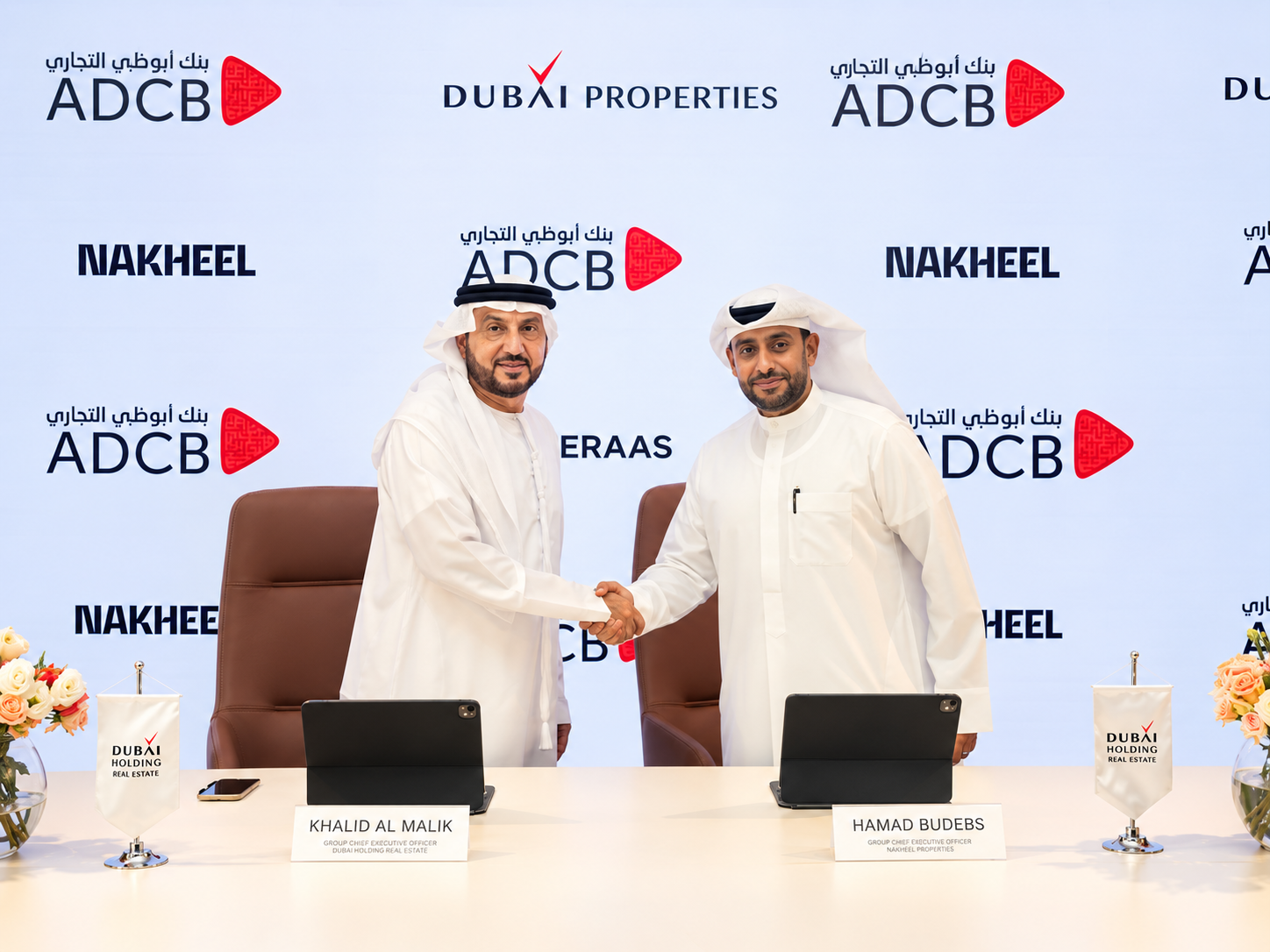
A new financing arrangement between Dubai Holding Real Estate and Abu Dhabi Commercial Bank (ADCB).
Eligible buyers at Palm Jebel Ali, The Acres and Nad Al Sheba Gardens can now potentially access home financing once they’ve paid 50% of the property value to the developer, regardless of how far construction has progressed.
What actually changed?
You’re buying an off-plan home and following the developer’s payment plan.
Normally, you might continue funding those instalments from your own cash while the project moves through construction, with mortgage availability often connected to the property’s eligibility and prescribed construction milestones.
Under this specific Dubai Holding Real Estate and ADCB arrangement, eligible buyers in the three named communities can potentially reach the financing stage once 50% of the property’s value has already been paid to the developer, even if construction hasn’t reached a corresponding percentage.
In simple terms:
You fund the first 50% → ADCB financing may then become available for the remaining portion, subject to approval and the bank’s lending criteria.
ADCB separately states that eligible off-plan customers can receive financing of up to 50% of the property value, subject to credit assessment and its terms and conditions.
And that’s the interesting part.
You’re potentially creating a bridge between the developer payment plan and bank financing much earlier in your planning.
Let’s put some numbers around it
Imagine you’re buying an eligible property for AED 10 million.
You’ve already paid:
AED 5 million — 50%
Instead of automatically assuming that another AED 5 million needs to remain available from your own cash reserves, you may now have the option of financing some or potentially all of that remaining portion through ADCB, depending on your eligibility and approved financing amount.
That doesn’t suddenly make a AED 10 million property cheap.
But it can completely change how you manage your capital.
Maybe that remaining cash stays invested elsewhere. Maybe it’s available for your business. Maybe you’re buying more than one property. Or maybe you simply don’t like the idea of parking almost all your liquidity into an asset that hasn’t handed over yet.
And then there’s the 3.49% headline
ADCB’s pricing under the partnership starts from 3.49% per annum, fixed for three years. The Dubai Holding announcement also says eligible buyers can benefit from mortgage pre-approvals valid for up to 18 months, with processing and valuation fees waived.
Sounds attractive.
But let’s not turn “from 3.49%” into “everyone gets 3.49%.”
Those are two very different statements.
The actual rate, financing amount and final approval will depend on ADCB’s credit assessment, your financial profile, the property and the bank’s applicable terms. ADCB itself states that financing remains subject to its approval and acceptable documentation, and that advertised rates can change.
So when someone tells you, “You can get a 3.49% mortgage,” the next question should be:
“Am I actually eligible for that rate?”
That’s a much better conversation.
Why Palm Jebel Ali makes this particularly interesting
Palm Jebel Ali is probably the obvious example.
We’re talking about a major waterfront development where buyers can be committing substantial amounts of capital to a property years before final handover.
And when ticket sizes get bigger, liquidity starts to matter just as much as price.
There’s a big difference between owning an expensive property and having all your available cash sitting inside that property.
That’s why financing can matter even to buyers who technically don’t need a mortgage.
Sometimes leverage isn’t about stretching your budget.
It’s about keeping options open.
An investor may comfortably have enough cash to continue paying the developer, for example, but prefer to use bank financing for part of the remaining purchase price and keep their own capital available for another investment, their company or simply as a reserve.
That’s a very different use of a mortgage from someone borrowing because they can’t otherwise complete the purchase.
The same structure applies to The Acres and Nad Al Sheba Gardens
The special 50%-paid structure also covers eligible buyers at Meraas’ The Acres and Nad Al Sheba Gardens.
And these aren’t random projects.
The Acres is a villa-led community in Dubailand, while Nad Al Sheba Gardens is a gated villa and townhouse community located close to established parts of central Dubai. Meraas continues to invest heavily in construction across both communities; in 2026 it announced AED 2.4 billion in construction contracts for new phases of The Acres and The Acres Estates, while a separate nearly AED 1 billion contract was awarded for Phase 7 of Nad Al Sheba Gardens.
But again, the financing is what changes the conversation.
For someone comparing two off-plan villas with similar prices, you now have another question to put on the table:
How much of my own cash needs to remain committed until handover?
That’s something buyers sometimes overlook.
They compare price per square foot, plot size, bedrooms, location and expected appreciation…
All useful.
But the payment structure can be just as important as the property itself.
Does this apply to every Nakheel, Meraas or Dubai Properties project?
No.
And this is probably the most important clarification in the whole story.
The ability to access financing after paying 50% regardless of construction progress is specifically highlighted for eligible purchases at:
- Palm Jebel Ali
- The Acres
- Nad Al Sheba Gardens
The wider partnership does extend ADCB off-plan financing to other qualifying residential communities across Nakheel, Meraas and Dubai Properties, but those properties are subject to prescribed construction milestones.
So this isn’t a new blanket rule saying:
“Pay 50% on any Dubai off-plan property and a bank will finance the rest.”
That’s not what was announced.
It’s a specific financing programme between Dubai Holding Real Estate and ADCB, with particularly favourable timing for the three communities above.
And buyers should treat it that way.
There’s a bigger shift happening here
What I find interesting isn’t only this particular mortgage product.
It’s what we’re starting to see around it.
Dubai Holding Real Estate has been building several financing partnerships during 2026. Earlier this year, it announced separate arrangements involving Emirates NBD, Commercial Bank of Dubai and Abu Dhabi Islamic Bank across properties within the Nakheel, Meraas and Dubai Properties portfolio.
ADCB has also been expanding its own off-plan financing relationships. In July 2026, for example, the bank announced a separate collaboration with Emaar Development offering eligible customers pre-approval for financing of up to 50% of the property value.
So this isn’t really just a story about one interest rate.
We’re watching the relationship between off-plan property and mortgage financing become more closely connected.
For buyers, that could make financial planning considerably clearer.
And for investors… well, that’s where it gets interesting.
Because once financing becomes part of the off-plan conversation earlier, you can start evaluating a property based not only on its purchase price, but on how efficiently you can hold it.
Would I automatically take the mortgage?
Not necessarily.
Sometimes paying cash still makes more sense.
If you’ve got plenty of liquidity, don’t want monthly debt and value simplicity, there may be little reason to borrow just because financing is available.
But I’d absolutely run the numbers.
That’s the point.
Compare the cost of the mortgage against what that capital could realistically do elsewhere.
If you’re paying interest to keep AED 3 million liquid, for example, what are you planning to do with that AED 3 million?
If the answer is “leave it sitting in an account,” that’s one calculation.
If the answer is “use it to buy another asset or grow my business,” that’s another.
There isn’t one correct answer for everybody.
Before buying, ask these questions
If you’re looking at Palm Jebel Ali, The Acres or Nad Al Sheba Gardens and you’re considering this financing structure, don’t stop at the advertised rate.
Ask:
How much will ADCB actually finance for me?
When can the financing be released against my developer payment schedule?
What rate do I personally qualify for?
What happens after the three-year fixed period?
What’s my total financing cost over the period I expect to hold the property?
And, most importantly, is financing actually better for my situation than continuing to pay cash?
Those answers matter far more than a headline percentage.
The bottom line
The interesting news here isn’t simply that there’s a 3.49% starting rate.
It’s that selected Dubai off-plan buyers may no longer have to think about their purchase as one long sequence of cash payments stretching all the way towards handover.
For eligible buyers at Palm Jebel Ali, The Acres and Nad Al Sheba Gardens, the first 50% can potentially be funded personally, with bank financing becoming an option after that point, regardless of construction progress and subject, of course, to ADCB approval.
That gives buyers another tool.
Not free money. Not guaranteed approval. And certainly not the right solution for everybody.
Just another way to structure the deal.
And in my experience, that’s often where the smartest property decisions begin — not with asking “Which project should I buy?”
But with asking:
“How should I use my money to buy it?”
At Cielo Properties, that’s the conversation we’d rather have with you. Not simply what’s launching this week, but how the purchase actually fits your cash flow, investment plans and longer-term strategy.
Because a good property can still be a bad purchase if the financing doesn’t make sense for you.